

The Sales Process - Step 1
This series explores the steps to converting an ideal prospect into a closed client.

This is part two of a five-part series on the sales process. Find part one here.
I’ve never thought of myself as a “salesperson.”
Like many of you, I don’t want to be viewed as “salesy.”
Images of a greasy used car salesman instantly spring to mind.
But the simple fact is - if I didn’t know the basics of selling, I wouldn’t have the business I have. I wouldn’t have made it 10 years as a consultant. I wouldn’t have closed a fraction of the deals I’ve closed.
I think it’s more than possible to learn sales fundamentals and then apply them in a way that makes sense for your style, personality, and values. You don’t have to embody someone else’s idea of what it means to “sell.”
You can make it your own.
Today I’m going to dig into the first step in the sales journey. The first critical hurdle we have to get past in order to take your ideal prospect all the way down the road to becoming a closed client (plus several specific ways you can overcome this hurdle). Read on…
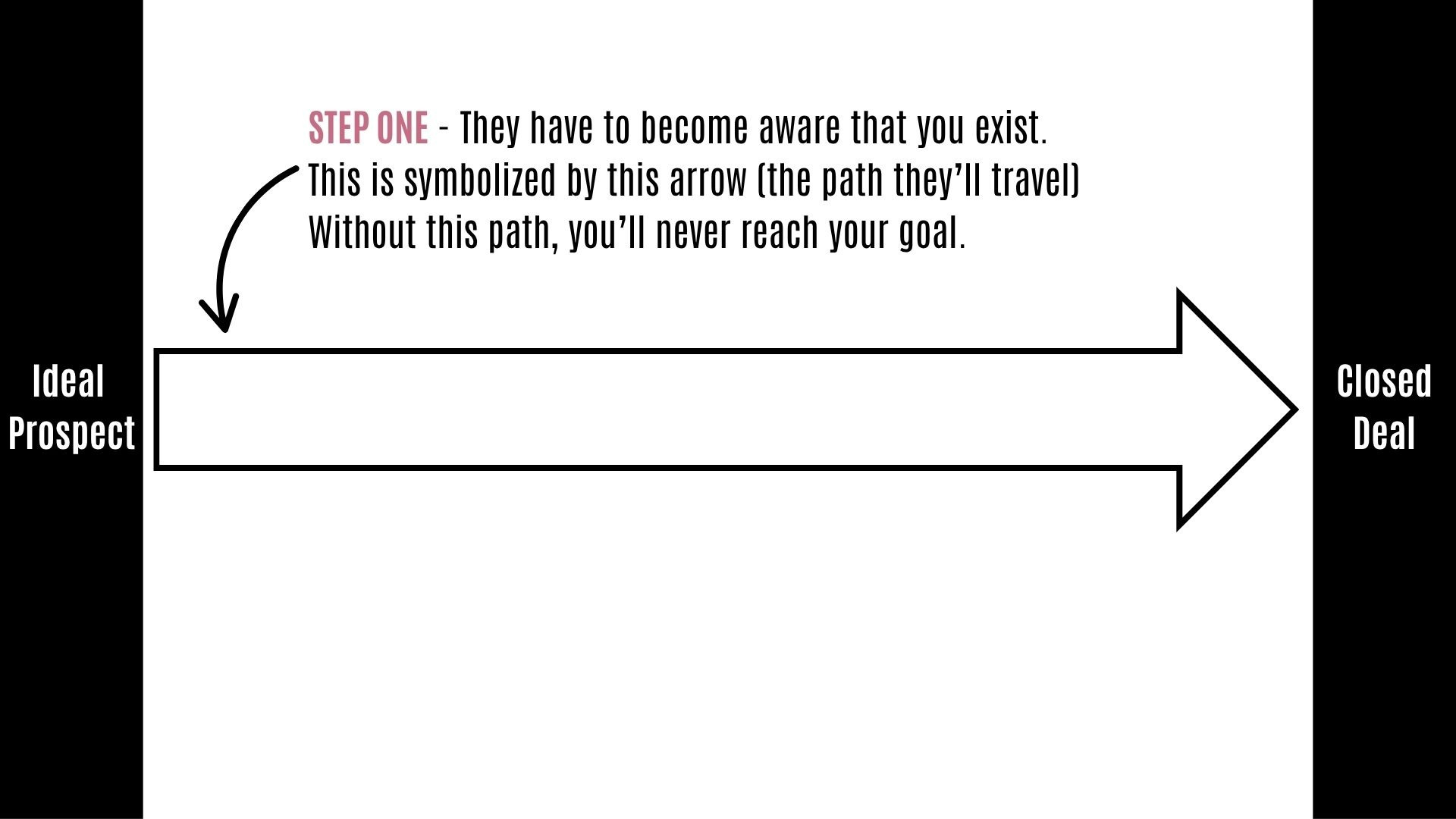
STEP ONE in the sales process is a very obvious one, but it’s absolutely critical nonetheless. At some point, in some way, your ideal client has to become aware that you exist.
I’m not talking about knowing you personally, or understanding your services, or trusting you. I’m only speaking about awareness of you as a person on this planet.
If they don’t know who you are, they will never work with you. Simple as that.
Here’s another way to think about it:
Your ENTIRE pool of future clients is currently limited to the pool of people who know you exist.
Consider how large or small that group is.
Consider how enormous the group outside it is.
Odds are that your current pool of potential future clients is somewhere between a few hundred and a few thousand.
No matter the size of your current potential market, it’s going to become important to work on expanding it.
Most solopreneurs and consultants put far too much emphasis on expanding their services and offerings - and not nearly enough focus on expanding their reach.
You’re not going to make that same mistake.
You’re going to make a concerted effort to continuously expand your pool of potential future clients.
But how?
It all starts with weaving ‘audience expansion’ into your weekly list of important priorities.
Decide you’re going to make a “no excuses” commitment to doing this each and every week. It doesn’t need to take more than 1-2 hours per week.
Even when you’re fully booked with client work, you can and should spend this time on growing your potential future client list. Your efforts will compound tremendously over time, and Your Future Self will thank you - believe me.
Here are a few ideas for how to spend that weekly time:
Occasionally forget your ICP - Instead, produce content with mass appeal. We’ve all heard the counsel that your publicly available content should tightly target your ideal client. And that’s great advice. But occasionally - say, twice a month - aim to produce a piece of content that’s likely to appeal to a broad swath of the population. This will organically expand your reach and bring new eyeballs to your platform. Remember - even if they’re not your ICP, they may know your ICP.
Here’s an example from my own business - my LinkedIn content is overwhelmingly targeted toward communications leaders (my ICP), but here and there I produce tips and insights for job seekers (the largest user base on LinkedIn). This kind of generosity and goodwill is a win for my brand reputation, but even more importantly - it expands my reach far beyond the usual folks who would see my stuff.
Ask for introductions to new people (and make it as easy as humanly possible to facilitate those introductions). Don’t think about them as “referrals” (that term is loaded with expectation). Instead, think of them as introductions. You’re simply going to your warm contacts to ask if they can introduce you to one or two new people this month. You're going to share a brief intro blurb to make it easy to copy / paste. You might even ask if they’d be open to you looking at their LinkedIn connections so you can connect directly and use their name (no action needed on their part).
Your key message isn’t “I’m looking for new clients.” It’s “I’m on a mission to expand my network this year - can you help me to meet some new people?”
Expand your content to new platforms and channels. If you’re already nailing the basics with your positioning, that means you’re already sharing your insights and content somewhere. Perhaps on LinkedIn, perhaps in a blog or a newsletter, or maybe you have a podcast. But now may be the time to establish yourself on a new platform or channel. You can repurpose / rework your existing content archive for a new channel, and slowly build up your reach in that new space over time. Many of us have strong preferences for specific platforms and channels - so you’ll often reach an entirely new segment of the population by showing up in a new way. Here are some content formats to consider:
Reddit
Substack
Podcast
Newsletter
Blog
YouTube long-form
YouTube shorts
Instagram carousels
Instagram reels
Threads
Meta / Facebook
Bluesky / X
TikTok
LinkedIn long-form
LinkedIn short-form
LinkedIn carousels or videos
Visit the “my network” tab on LinkedIn and review the list of suggested new connections. You’ll see people who went to your same university, people who worked for your previous employers, people who share connections with you, and people who work in a similar role as you. Send out weekly connection requests with personalized, informal notes to say hello. Give yourself a weekly target (LinkedIn will allow you to send as many as 100 of these per week, which could mean 5,000 new connections in a year).
Tell them exactly how you found them, and don’t pitch. Just make a genuine connection. Here’s a sample message for a person who went to my school (University of Missouri Columbia) and now works at Microsoft:
Hey Stacy, LinkedIn put you at the top of my suggested connections this week - looks like you’re a fellow Tiger (M-I-Z!) How’s life at Microsoft treating you?
Next time we’ll dig into STEP TWO in the sales process (taking your ideal prospect from simple awareness to deep understanding).